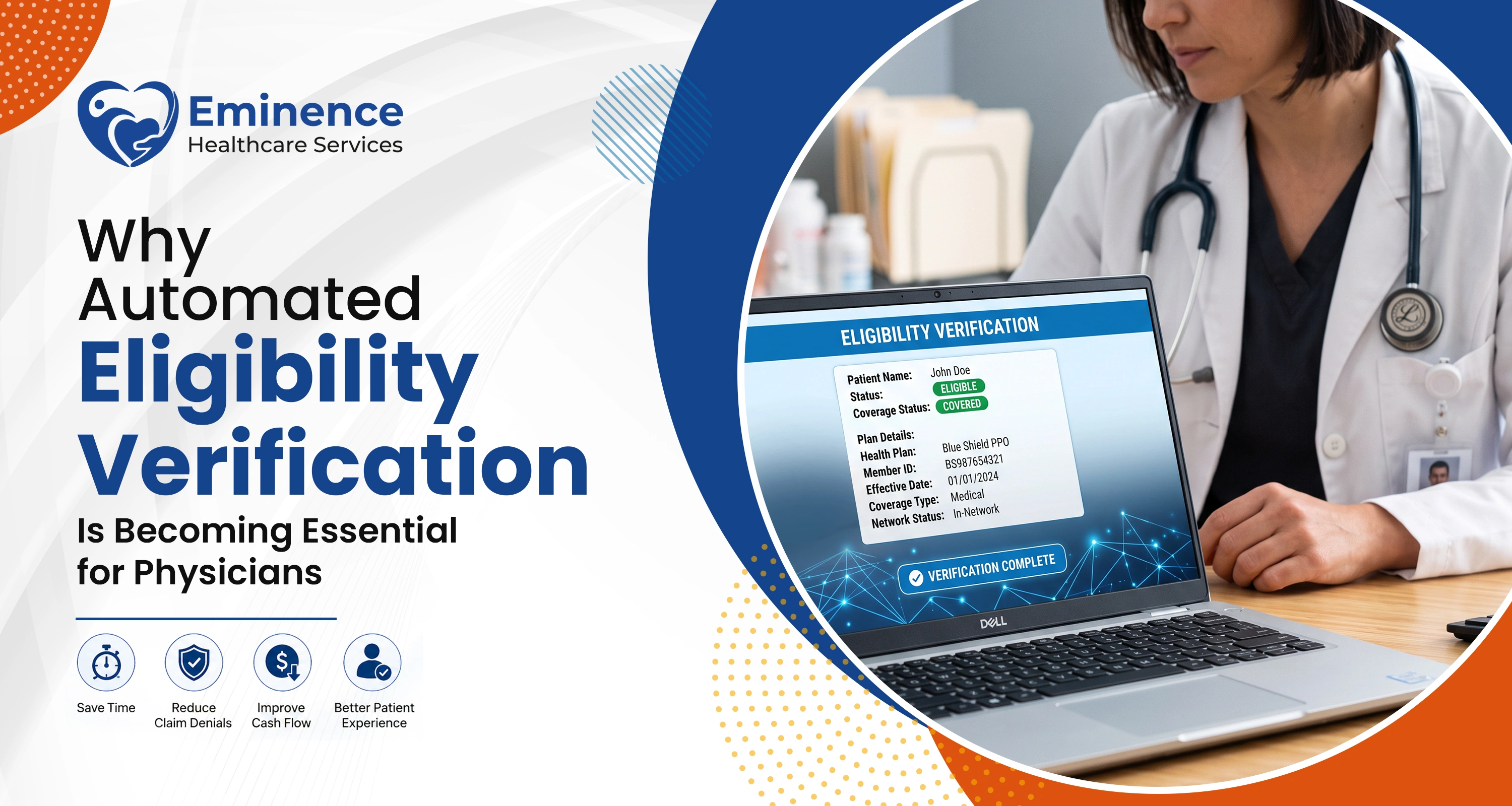
Why Physicians Are Replacing Manual Checks with Automated Eligibility Verification
Nearly half of all claim denials in the US healthcare system trace back to one preventable cause: eligibility and coverage issues that were never checked before the appointment happened. Not a coding error, not a documentation gap, nothing huge, just a patient whose coverage had already lapsed; discovered three weeks later, when the claim bounces back denied.
Eligibility verification is the step built specifically to catch this before it happens. And it remains one of the most frequently skipped or rushed steps in the entire revenue cycle because doing it properly, for every patient, every time, has historically taken more staff time than most front desks must give.
This blog looks at why manual verification keeps failing, what automation changes, and what physicians need to know before adopting it.
What Is Automated Eligibility Verification?
Automated eligibility verification is a real-time electronic process that confirms a patient's active insurance coverage, benefits, and cost-sharing details before a claim is submitted, replacing manual phone calls and payer portal lookups with instant, standardized checks.
The mechanism behind it is an EDI 270/271 transaction, a structured electronic request sent to a payer, and a structured electronic response confirming coverage status, copay amounts, deductible remaining, and authorization requirements. What used to take a staff member 10 to 15 minutes on the phone now takes under 60 seconds. That is not a marginal efficiency gain. At volume, across hundreds of weekly appointments, it changes what is operationally possible for a front desk team.
Why Are Manual Eligibility Checks So Unreliable?
Manual eligibility checks fail for reasons that have nothing to do with staff competence and everything to do with how the process is structured. A phone call to a payer, or a login to a portal, depends entirely on accurate transcription, the representative's information being current, and nobody being interrupted halfway through.
The numbers make the case better than any explanation. According to HFMA's 2025 Revenue Cycle Benchmarking Survey, insurance verification errors cause 30 to 40% of all initial claim denials. A single transposed digit in a policy number, a coverage change that happened the week before the appointment, a secondary insurance that was never mentioned; any one of these slips through a manual process and surfaces three weeks later as a denial nobody saw coming.
There is also a sheer volume problem. A practice seeing 100 patients a day, with a staff member spending 13 minutes per verification, is looking at over 21 hours of phone-and-portal time daily just to confirm coverage; time that exists nowhere in most front desk staffing models, which is exactly why so many practices quietly skip the step or do it inconsistently.
How Does Automated Eligibility Verification Reduce Denials?
Automated eligibility verification reduces denials by catching coverage problems before the appointment happens, not after the claim has already been submitted and rejected. That timing difference is the entire point.
Here is what the data shows when practices make the switch:
| Metric | Manual Verification | Automated Verification |
| Time per check | 10–15 minutes | Under 60 seconds |
| Eligibility-related denial reduction | Baseline | 40–75% reduction reported |
| Verification frequency | Limited by staff capacity | Can run at scheduling, 48–72 hours pre-visit, and day-of |
| First-pass claim acceptance | Lower, inconsistent | Significantly improved |
| Cost per verification | Staff time plus hold time | Roughly $8.64 saved per transaction |
Practices running real-time automated verification at the scheduling stage, 48 to 72 hours before the appointment, report a 40 to 60% reduction in day-of-service denials. Running a second check on the actual day of service catches the cases where coverage changed in the days between booking and arrival. One touchpoint misses what three touchpoints catch.
Key Insight
According to MGMA data, practices that implement systematic eligibility re-verification on the date of service reduce claim denials by 43%. Separately, automated pre-service verification has been shown to reduce eligibility-related denials by an average of 47% within the first six months of implementation, per HFMA's 2025 benchmarking survey.
Why Does Prior Authorization Make Eligibility Verification Even More Important?
Prior authorization and eligibility verification are not the same process, but they are sequential, and skipping the connection between them is one of the most expensive mistakes a practice can make. Eligibility verification confirms that a patient has coverage. Prior authorization confirms that the payer will approve payment for a specific service before it is delivered.
The scale of the problem here is significant. According to the American Hospital Association, 93% of physicians report that prior authorization delays access to necessary care, and the average practice completes 41 prior authorizations per physician every week. Missing one produces exactly the kind of denial that looks like a clinical decision gone wrong but is actually a process of failure.
The two processes work best when they are checked together, at the same moment. During eligibility verification, a properly configured system should simultaneously flag whether the planned service requires prior authorization; so, the practice is never in the position of delivering care it cannot bill for, discovered only after the fact.
How To Choose the Right Automated Eligibility Verification Solution?
Not every automation vendor is built the same way, and the gap between a good implementation and a poor one shows up directly in denial rates within the first 90 days.
Step 1: Confirm clearinghouse and EHR integration depth
According to HFMA, 78% of medical practices have clearinghouse relationships, but only 51% have activated eligibility query capabilities. Confirm that the vendor integrates directly with your existing EHR rather than requiring a separate, disconnected system.
Step 2: Check payer coverage breadth
Most established clearinghouses connect 900 to 1,000 payers for eligibility queries. A vendor with narrow payer coverage will leave gaps exactly where your patient mix needs them covered.
Step 3: Verify HIPAA compliance documentation upfront
Any vendor handling ePHI must provide a signed Business Associate Agreement, demonstrate AES-256 encryption at rest and TLS 1.2 or higher in transit, and maintain audit logs for a minimum of six years under the HHS HIPAA Security Rule. A vendor unable to produce this should not be handling your verification workflow.
Step 4: Set verification touchpoints, not just one check
Run verification at scheduling, again 48 to 72 hours before the appointment, and once more on the day of service. Each touchpoint catches a different category of change, and running only one leaves the other two unprotected.
Step 5: Track your baseline before implementation
Capture your current eligibility-related denial rate, average verification time, and first-pass claim acceptance rate before switching. Without a baseline, it is difficult to measure whether automation is actually delivering the improvement it promises.
How Does Eligibility Automation Fit into Broader Physician Billing Management?
Eligibility verification is one piece of a much larger structure, and it only delivers its full value when it is genuinely connected to everything downstream in physician billing management; coding, claim scrubbing, denial tracking, and payment posting.
A practice that automates eligibility checks but still manages coding and denial follow-up manually has fixed one weak link in a chain that has several. The practices seeing the strongest results, 40 to 70% reductions in front-end denials within 90 days, are the ones running eligibility automation as part of a structured physician billing management process, not as an isolated tool bolted onto an otherwise unchanged workflow.
That is the distinction worth sitting with. Automation solves the eligibility problem specifically. It does not solve a fragmented revenue cycle on its own. The two need to move together.
Eminence RCM integrates automated eligibility verification into a complete physician billing management process.
Get in touch to find out where your verification process currently stands.
Reach out now!
Frequently Asked Questions
Studies show that switching from manual to electronic verification saves approximately $8.64 per transaction, primarily through reduced staff time. For a practice seeing 100 patients daily, automation can reduce verification time from roughly 13 minutes to under one minute per patient, translating into significant recovered staff hours every week, beyond the direct denial reduction.
Most established automation platforms integrate directly with EHR and practice management systems; some support 80 to 150 or more integrations. Confirm this specifically before selecting a vendor, since a system requiring manual data re-entry between platforms undermines much of the efficiency gain automation is meant to provide.
Yes, provided the vendor meets specific requirements, a signed Business Associate Agreement, AES-256 encryption for data at rest, TLS 1.2 or higher for data in transit, and audit logs maintained for at least six years under the HHS HIPAA Security Rule. Any vendor unable to produce this documentation should not be trusted with patient eligibility data.
Best practice is three touchpoints, at scheduling, again 48 to 72 hours before the appointment, and once more on the day of service. Each catches different changes. A coverage lapse that happened the week before an appointment will be missed by a check done only at scheduling, which is why a single verification point leaves practices exposed.
Eligibility verification confirms that a patient has active insurance coverage and what their benefits include. Prior authorization is a separate approval a payer must grant before certain services will be reimbursed. They are sequential, not interchangeable, a patient can have valid coverage and still have a claim denied if the required prior authorization was never obtained.
Yes. A properly configured eligibility system should flag during the same check whether a planned service requires prior authorization, surfacing that requirement at scheduling rather than after the appointment has already happened. This does not replace the authorization process itself, but it prevents the common failure of discovering an authorization was needed only after the service was already delivered.
Still have questions?
Contact Us.webp)