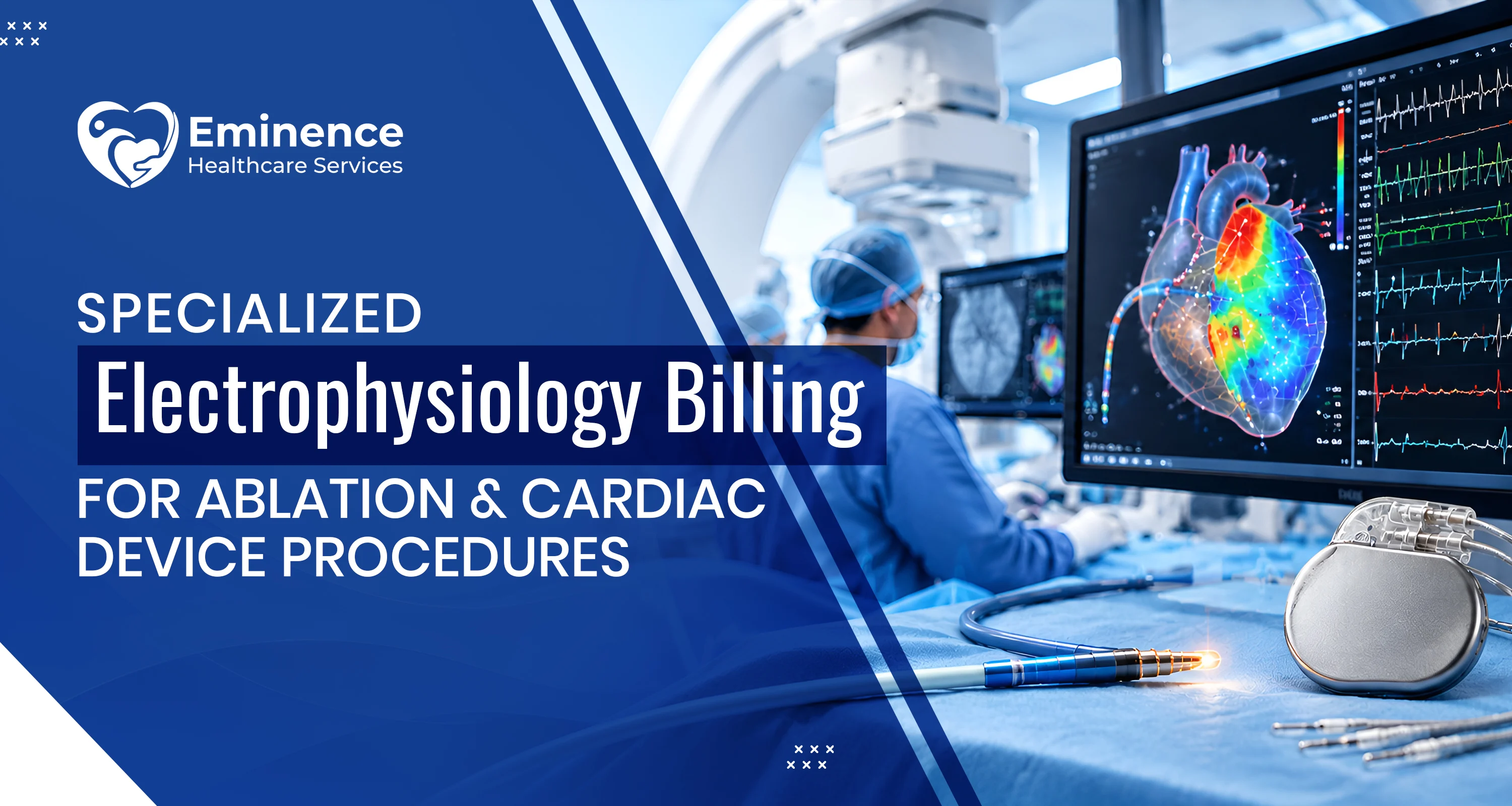
Expert Electrophysiology Billing for Ablation and Cardiac Device Procedures
Electrophysiology sits on the extreme end of billing complexity within the field of cardiology. The processes require high technical skill, because the CPT codes undergo frequent changes, the documentation required is extremely complex, and 2026 is the most significant year for regulatory change.
Cardiology billing services that specialize in electrophysiology know the implications of the regulation change in practical terms. On January 1, 2026, CMS included important EP ablation codes 93650, 93653, 93654, 93656, and associated add-on codes to the Ambulatory Surgery Center Covered Procedures List.
This amendment widened the scope of billing for EP physicians who perform catheter ablation, made new requirements regarding the documentation of the place of care, and established a whole new type of billing mistake for EP clinics who have not adapted to the change.
For a specialty so crucial with its procedures and high rates of prior-authorization denials, improper billing can be very expensive!
Why is Electrophysiology Billing So Complex?
Electrophysiology billing is very complex because it involves very expensive and time-consuming procedures, which are subject to CPT hierarchy rules, device requirements, site-of-service dependence, and documentation. To add, the documentation needs to strictly match across the physician note, procedure note, and the technical portions of the claim at the same time.
The add-on criteria are very intricate, and any vague information will result in a denial sooner than you can imagine. Cardiology billing services like Eminence RCM exist for this very reason.
The ablation procedures need to be documented for the mechanism of the arrhythmia, the method of mapping, the energy source used, and the endpoint of the procedure. The cardiac device procedures include the correct device code identification, number of leads, and whether it is a new implantation, upgrading, or revision of the device.
What Are Common Electrophysiology Billing Errors?
The most common EP billing errors are missing the "6- component" documentation that is a must, unbundling comprehensive EP ablation codes, using mismatched add-on codes for mapping and pacing, prior authorization failures, incorrect usage of device or lead count for implants or overusing or misusing modifier 59 as well as its subsets.
Modifiers do cause most of the issues. When the physician delivers both services at a non-facility practice, the modifier 26 should not appear in the claim. However, when the physician delivers the professional interpretation only, then the modifier 26 becomes mandatory.
This wrong application of modifier leads to a significant loss of revenue for the EP claim, where both the allowed amounts on each service are relatively high, without necessarily causing a denial claim.
How Does Denial Management Protect Revenue Loss in EP?
In EP, good denial management practices classify each claim denial at the time of receipt by its cause, route that category of claim to the proper resolution process, and monitor every outstanding denial against the deadline for appeal by the payer because EP denials not worked after appeal expiration result in irrecoverable revenue loss on highly valuable claims.
Prior authorization plays a significant role in EP denial management. Atrial fibrillation ablation, one of the most rapidly growing EP procedures in the US, requires prior authorization from almost all commercial payers and Medicare Advantage organizations. Mismatched or missing prior authorization results in a hard denial. It cannot be billed to the patient in most instances.
Why Do EP Practices in California Need Special Billing Support?
Specialist medical billing services California, used by EP practices, have a good understanding of the California payer landscape, the high volumes of commercial managed care with some of the toughest prior authorization requirements in the nation, resulting in a billing environment in electrophysiology that is unique from national norms.
Specialist billing services California like Eminence RCM understands the specific details surrounding which California commercial payers have the toughest prior authorization requirements around AF ablation, the details of medical necessity documentation required for CIED procedures in the most active Medicaid managed care organizations in California, and the complexities involved with billing site-of-care changes associated with the expansion of ASCs in 2026 in California.
Take a leap of faith and reach out. Read more on our website
Frequently Asked Questions
The main codes for electrophysiological ablation include 93650 (ablation of AV node), 93653 (ablation of supraventricular tachycardia), 93654 (ablation of ventricular tachycardia), and 93656 (atrial fibrillation ablation with pulmonary vein isolation). Starting January 1, 2026, CMS included these codes in the ASC Covered Procedures List, thus allowing their billing in ambulatory surgery centre environment for the first time.
The most common reasons for an EP claim denial are authorization issues related to ablation procedures, wrong code sequence for ablations add-ons, incorrect coding of devices procedures for generators replacement, lack of information about arrhythmia mechanism, mistakes in modifier use in professional/technical components claims, and mismatch between site-of-care after 2026 ASC extension.
Yes; for almost all commercial payers and Medicare Advantage plans. Requirements for prior authorization are especially high for atrial fibrillation ablation, which is one of the fastest-growing and most scrutinized EP procedures. Authorizations should correspond to the particular procedure, arrhythmia being treated, and the specific anatomic approach. Any deviation would necessitate obtaining a new authorization before starting the procedure.
CMS released its Final CY 2026 HOPPS and ASC Payment System Rule including cardiac catheter ablation codes into the ASC Covered Procedures List as of January 1, 2026. Codes include AV node ablation, SVT ablation, AF ablation with pulmonary vein isolation, and ventricular arrhythmia ablation. All primary ablations were assigned J8 device-intensive payment indicators for ASC performance.
CIED billing depends on knowing the specific type of device, single or dual chamber, the lead number, and the service type: new implantation, generator replacement, lead addition, or revision. In each case, you will get a different CPT code and reimbursement rate. Generator replacement that is billed as a new implant is over coding. The type of device, lead number, and indication for use must be specified in documentation for compliant billing.
If there is a greater than 10% denial rate for ablations, if authorization failures are generating non-billable procedures, if there are concerns about 2026 ASC expansion billing, or if the billing staff lacks expertise in the relevant CPT codes and modifiers. The lost revenue associated with generalist billing of the complex and high-value electrophysiology procedures generally far outweighs the cost of outsourced help, and many practices see positive results in the first quarter alone.
Still have questions?
Contact Us.webp)